
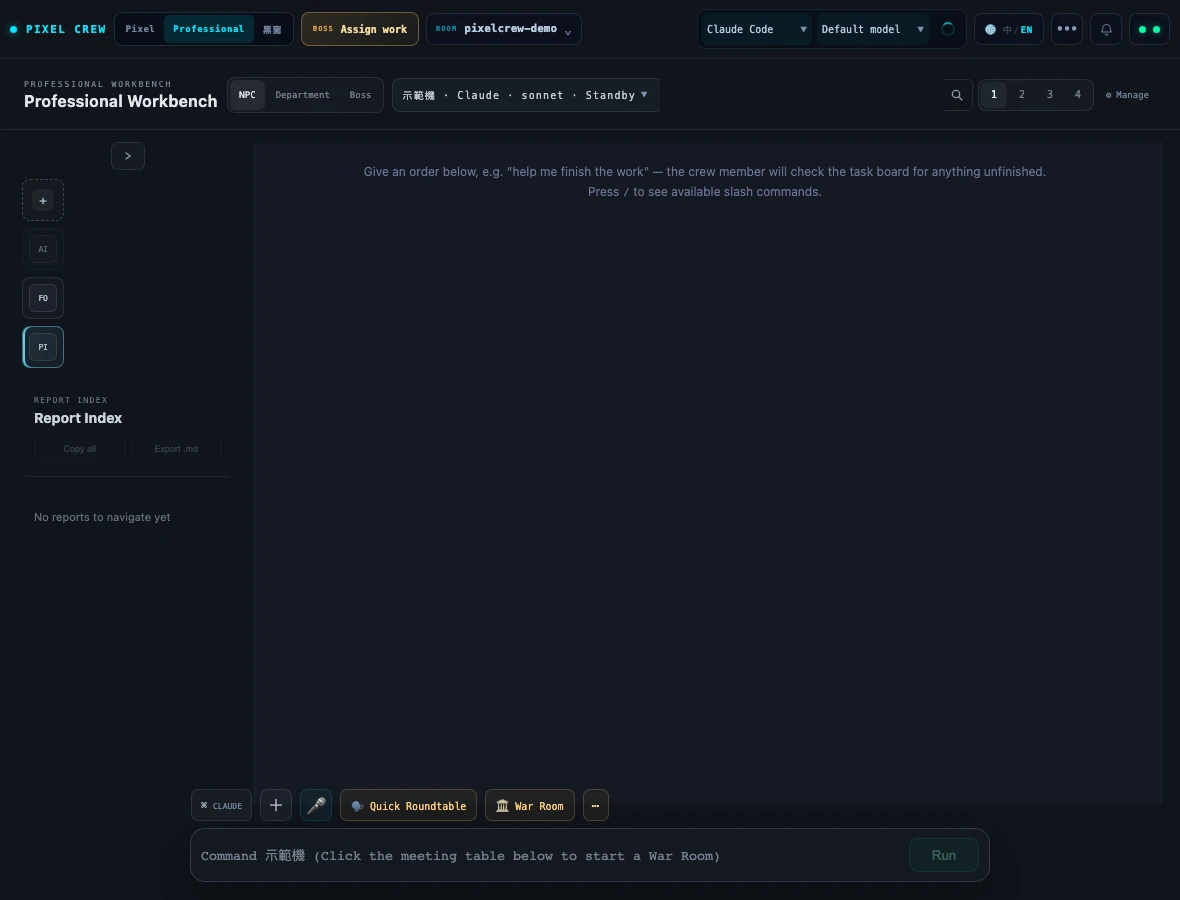
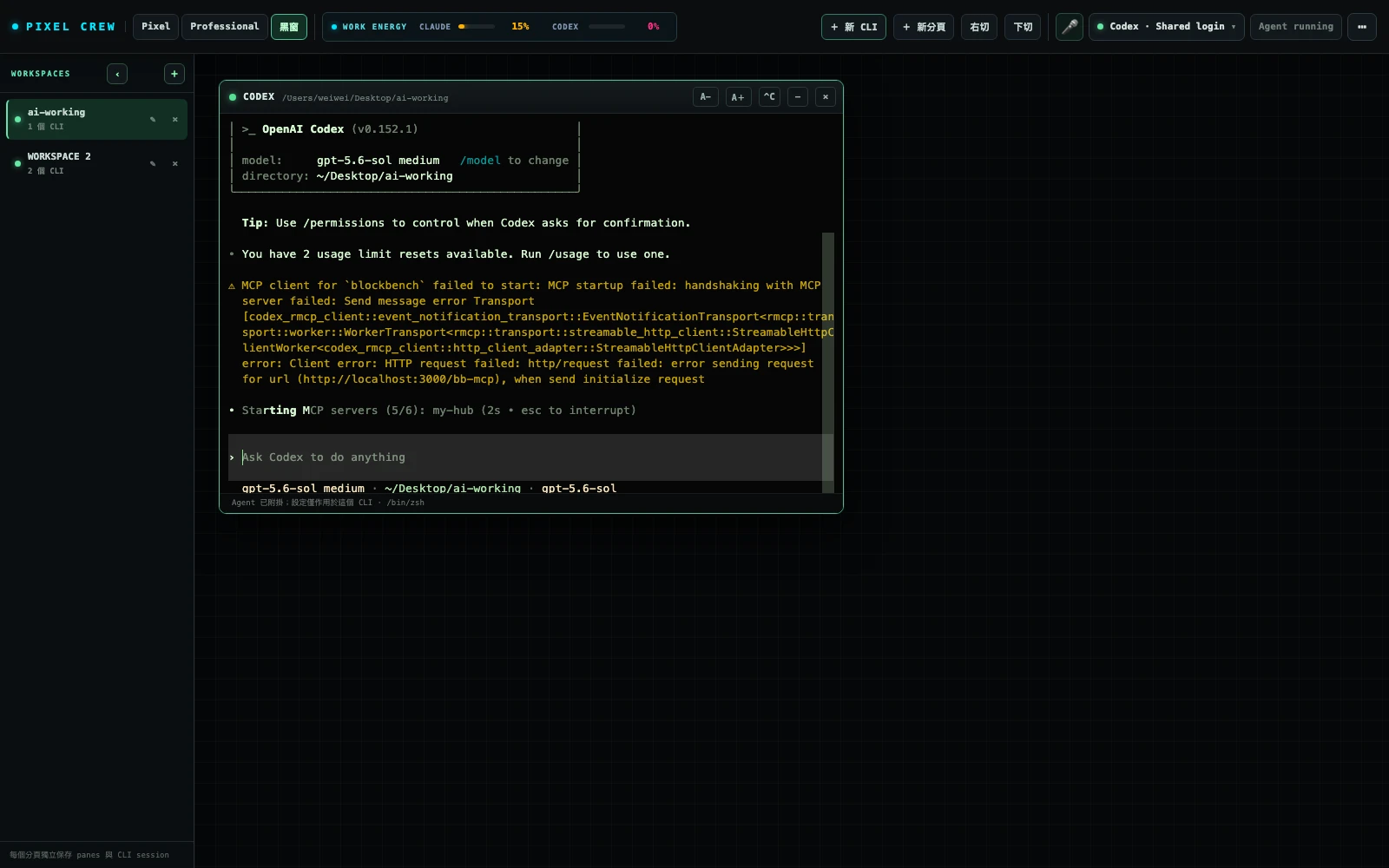
Turn Claude Code and Codex into a pixel crew that organizes itself.

Pixel Crew is a multi-agent cockpit that runs on your computer. Assign work to a single NPC, or hand it to an entire department — the department's lead decides who to consult, who reviews, or whether to run a 2-to-5-step Mission, every step visible and approvable.

MIT open source Local-first・No API key macOS/Windows/Linux Native official CLI integration Departments route themselves
PIXEL CREW — ROOM AAAALIVE CAPTURE
Pixel Crew's full interface: four NPCs at their workstations, NPC five selected with a live speech bubble reading 'Good morning! What should we work on today?', the task log on the right mirroring the same reply, the personnel list on the left, and the command input at the bottom

▲ Captured from the real app — NPC five says good morning, and the task log on the right records the same line.

2OFFICIAL CLI INTEGRATIONS
20CONCURRENT NPCS
0API KEYS TO PASTE
100%DATA STAYS LOCAL
MITLICENSE
WHAT'S NEW · TEAM COLLABORATION

2.0.0 lets departments pick up work and hand it off on their own.

This isn't a few new buttons — it's a whole layer of delegation. Hand a goal to a department and its lead will find an expert to consult, ask someone to review, or run a full Mission — every step still stops where you can see it and approve it.

v2.0.0 Full release notes ↗
01 / DEPARTMENTSCreate a department, AI drafts the roles

Fill in a purpose, headcount, and provider; AI drafts complementary roles and personas, you pick a lead, and the department is created with the rest of the NPCs in one click.

02 / HANDOFFThe lead picks how to collaborate

You only write a goal and acceptance criteria; the lead decides whether to run Quick Consult, Quick Review, or a full Mission.

03 / CONSULT & REVIEWTwo-step, read-only collaboration

An expert NPC advises or reviews existing work, and the lead executes and finalizes it — entirely read-only, never touching your files.

04 / MISSIONA full 2-to-5-step task chain

Always starts with an execute step; every review step is done by a different NPC; failed reviews get up to two automatic correction rounds.

05 / GUARDRAILSDangerous actions always wait for you

No mode ever auto-commits, pushes, merges, tags, or releases, and none of them touch your authentication.

06 / VISIBILITYOnly real blockers interrupt you

A plan awaiting approval, an inconclusive review, a used-up correction budget, a failed step, or a member going offline — those five cases stop for you; everything else hands off automatically.

Create-department dialog: enter the department's purpose, headcount, and provider; AI drafts a list of complementary roles and personas for the user to pick a lead from
DEPARTMENT — AI drafts complementary roles
Hand-to-department dialog: enter a task goal and one acceptance criterion per line, then confirm to hand it to the department for the lead to route automatically
MISSION — write a goal, the lead routes it
A needs-attention state: a Mission has stopped because a review result was inconclusive, waiting for the user to decide the next step
NEEDS ATTENTION — only blockers interrupt you
SIGNATURE · 2.0.0

Hand the work to a department, and let the lead decide.

A department is two or more NPCs sharing one workspace, one of them designated the lead. Create one directly with the Department Creator: fill in a purpose, headcount, and provider, and AI drafts complementary roles and personas — you just pick who leads. From then on, every time you hand off work you only write a goal and acceptance criteria; the lead decides whether to consult an expert, ask for a review, or run a full task chain.

  • AI-planned departments: fill in purpose, headcount, and provider; AI drafts complementary roles and you pick a lead
  • Quick Consult / Quick Review: two-step, read-only collaboration — an expert advises or reviews, the lead executes and finalizes
  • Department Mission: a 2–5 step task chain that always starts with execute, with a different NPC doing each review step; failed reviews get up to two automatic correction rounds
  • Only five things stop for you: plan approval, an inconclusive review, a used-up correction budget, a failed step, or a member going offline — everything else hands off automatically
  • No mode ever auto-commits, pushes, merges, tags, or releases, and none of them touch your authentication
DEPARTMENT LEAD
QUICK CONSULT

Expert advises → lead executes (2 steps, read-only)

QUICK REVIEW

Expert reviews → lead finalizes (2 steps, read-only)

DEPARTMENT MISSION

2–5 step chain, execute/review alternating owners

MISSION — HAND TO DEPARTMENTLIVE
Hand-to-department dialog: only a goal and acceptance criteria are required; confirming hands it to the department lead to route automatically to Consult, Review, or a Mission
NEEDS ATTENTION — YOUR DECISIONLIVE
A department's status turned to needs attention: the screen lists why it stopped and the choices available for the next step
ASSIGN — NPC 1 RECEIVED A TASKREC
Recording: after being assigned a task, an NPC walks from its desk to a file-reading workstation and starts working, showing elapsed seconds and a streaming output bubble overhead; a neighboring coworker cheers on completion
SCENE 01 · ASSIGN WORK

Assign it, then watch it go to work.

Type a task and the NPC walks to the matching workstation — to read files, write code, search the web, or use the terminal. Its nameplate shows elapsed time while a speech bubble streams live output.

  • Workstation = tool: where the character stands shows what the agent is using
  • Completion reactions: nearby teammates celebrate success; failures produce a small storm cloud
  • This is an unedited recording of a real task
APPROVAL — WAITINGLIVE
Close-up: NPC one has an 'Allow this command?' approval bar overhead with deny, allow-for-task, and allow-once buttons; its nameplate shows a 9-second wait
SCENE 02 · APPROVALS

See who needs you, at a glance.

When an agent wants to run a command, its NPC stops, paces with a question mark overhead, and the approval controls float right beside the character. No window switching, no digging through logs — one glance across the office tells you who's stuck.

  • Three choices: deny, allow for this task, or allow once
  • Three auto-approval levels: off, safe (a read-only allowlist), or full (dangerous commands still force a confirmation)
  • Each NPC has independent settings
RADIAL — CONTEXT MENULIVE
Right-clicking NPC one fans out five circular icon buttons along an arc — rename, persona, appearance, room, and remove; a cat happens to walk across the floor on the left
SCENE 03 · RADIAL MENU

One right-click, every setting for this character.

Right-click any NPC to rename it, edit its persona, change its look, switch rooms, or safely remove it — and to ask another NPC at the same workstation for a read-only Consult or Review. For a bigger job, just create a department.

  • Persistent personas: give an NPC a durable role ("You're a frontend QA — only raise issues, never touch code") injected through each CLI's native mechanism; it survives restarts
  • Pixel Workshop: switch looks or upload your own animated GIF avatar
  • Cross-LLM handoff: let Claude summarize its progress partway through and hand off to Codex (or the other way around)
CAMERA — PAN & ZOOMREC
Recording: using the lower-left slider to zoom into the office, dragging to pan the view, then resetting to the default framing in one click
SCENE 04 · CAMERA

Your office, your point of view.

Drag empty space to pan, use the wheel or the lower-left slider to zoom — always in crisp integer steps. Double-click the floor or press to reset to the default framing.

  • Zoom in to follow one NPC, or pull out to see the whole office
  • Nameplates, bubbles, and approval controls move with the camera
  • Tablet-friendly: one-finger pan plus a slider for zoom
SCENE 05 · TASK LOG

Every step, out in the open.

The left panel shows a task in progress: the agent explains what it's about to look up while a WebSearch tool's input and output stream in live. The right panel shows the finished result: the final reply rendered as full Markdown — lists, links, sources — plus the tool-call count and total duration.

  • Two views: summary mode for the conclusion, activity mode for every tool call
  • Searchable: full-text search across this NPC's task history; one-click copy for code blocks
  • Desktop notifications: get a system notification when a task finishes or needs approval while you're in another window (off by default)
RUNNING — TOOL STREAMLIVE
Task log while running: NPC five explains its search plan while a WebSearch tool's INPUT and OUTPUT JSON streams in below
COMPLETE — FINAL RESPONSELIVE
Completed task: the final response renders lists and links as Markdown, noting 3 tool activities and a 36.1-second duration
SHIFT CHANGE — HANDOFFLIVE
Handoff dialog: NPC five handing off from Codex to Claude Code, showing the target LLM's work-energy bar plus a list of cross-LLM handoff caveats and a confirmation checkbox
OFFICE POWER — GLOBAL USAGELIVE
Global work-energy panel: Claude Code showing session, weekly, and per-model usage bars with reset times; Codex showing 7-day usage
SCENE 06 · HANDOFFS & ENERGY

Switch brains without dropping the work.

Running low on Codex allowance, or is this one better suited to Claude? Hand an NPC off between LLMs: the system first summarizes the current work, then hands it to a fresh session on the other model.

  • Global work energy: the top bar always shows live usage for both CLIs; open it for session, weekly, and per-model reset times
  • Check energy before switching: see the target LLM's live usage before handing off, so you don't run out right after switching
  • Honest warnings: it lists exactly what won't carry over (tool state, pending approvals) and requires a confirmation checkbox before proceeding; works Claude ⇄ Codex in either direction
SCENE 07 · PIXEL WORKSHOP

Make your crew look the way you want.

Swap between five official crew designs, or upload your own pixel GIF — animation timing is preserved and the avatar is automatically fitted to the NPC's size in the office, walking, working, and celebrating as usual.

  • Animated GIF avatars: up to 320×320 and 120 frames, looping at their original frame timing
  • Safe to switch: choosing an official look never deletes your custom character — switch back anytime
  • Pair it with the persona system so your "financial analyst" actually looks like one
OFFICIAL — CREWLIVE
Pixel Workshop's official tab: five official crew looks available — Classic Crew, Neon Engineer, Signal Analyst, Spark Designer, and Night Shift Ops
CUSTOM — GIF AVATARLIVE
Pixel Workshop's custom tab: previewing a blue animated pixel character, with GIF size, file, frame, and decode limits listed on the right
SECURITY MODEL

Your API key is safe — because there is no API key.

Pixel Crew isn't another service asking you to paste in a key. It orchestrates and visualizes the official CLIs already installed and signed in on your machine. Authentication, usage, and billing all stay in those tools — Pixel Crew never touches them.

Localhost only

The server listens on 127.0.0.1 and is never exposed publicly; the browser talks to it over a local WebSocket.

Native CLI authentication

Sign-in is managed by claude/codex themselves — Pixel Crew only invokes them, never stores any credential.

Data stays local

Conversation history, NPC settings, and avatars all live in a local SQLite database and folders — no cloud upload, no telemetry.

Dangerous-command guardrails

Even with full auto-approval on, destructive commands like rm -rf and disk operations still force a confirmation; a department Mission never auto-commits, pushes, merges, tags, or releases either.

RELEASE NOTES

What changed in each release.

From focused reading for long AI output to NPCs now forming their own departments — this is the history of every Pixel Crew release.

View all releases ↗
v2.0.1 LATEST

Boss task log and cross-department orchestration arrive

Assign work directly from a persistent Boss Desk; the decision model builds a dependency graph across departments and returns one consolidated report. Also adds mid-session model switching, live MCP config sync, and clearer diagnostics when Claude/Codex login detection disagrees with reality.

Full v2.0.1 release notes ↗
v2.0.0

Department management and read-only collaboration arrive

You can now create a department directly and let its lead decide between Quick Consult, Quick Review, or a full 2-to-5-step Mission; failed reviews get up to two automatic correction rounds, and dangerous actions always wait for your approval.

v1.0.3

Management, backup, and focus workflows in one cockpit

From MCP connections and local backups to full focus-mode controls, v1.0.3 makes daily maintenance more complete and long sessions safer.

v1.0.2

Reading, input, and multi-NPC workflow upgrades

Added focus reading, full-window attachment drops, persisted session state, early Codex command discovery, and persistent NPC ordering.

v1.0.1

Self-contained Windows build

Added a portable Windows x64 ZIP with a verified bundled Node.js runtime and production dependencies, plus a stable latest-release download link.

v1.0.0

Pixel Crew's first public release

The multi-agent pixel office, native Claude/Codex integration, approvals, personas, cross-LLM handoffs, usage monitoring, task logs, and the Pixel Workshop all launched.

GET STARTED

Three ways in — pick one.

Just two prerequisites: Node.js 22.13+ (source mode only), and at least one of the Claude Code / Codex CLIs installed and signed in.

MACOS

One-line install

A self-contained app with its own runtime — no Node.js or npm needed.

curl -fsSL https://github.com/juinwei7/\
Pixel-Crew/releases/latest/download/\
install-pixel-crew-macos.sh | /bin/bash
WINDOWS

Portable build

Download the zip, unzip, and run — includes a SHA-256 checksum and setup guide.

# After downloading from Releases
install-pixel-crew.cmd
start-pixel-crew.cmd
SOURCE

Run from source

Any platform — this is the path for development and customization.

git clone https://github.com/\
juinwei7/Pixel-Crew.git
cd Pixel-Crew
npm install
npm run dev   # localhost:5173

REQUIREMENTS ─ Node.js 22.13+ (source mode only)・Claude Code or Codex CLI・macOS / Windows 10 22H2+ / Linux

FAQ

Frequently asked questions

How is a department different from assigning a task to one NPC?

Assigning a task directly means a single NPC handles it start to finish. A department has at least two NPCs sharing one workspace, one of them the lead — you just write a goal and acceptance criteria and hand it to the lead, who decides whether to consult an expert, ask for a review, or run a 2-to-5-step task chain, stopping to ask you only when something's actually blocked.

Will a department auto-commit or push my code?

No. Whether it's running Quick Consult, Quick Review, or a full Mission, a department never auto-commits, pushes, merges, tags, or releases, and it never touches your authentication; normal CLI approval prompts still apply.

Is it free? Does it use more of my allowance?

Pixel Crew itself is completely free and MIT-licensed. It never handles billing — you're using your own CLI subscription or account allowance, exactly as if you ran the CLI directly; the usage meters in the top bar help you keep an eye on it.

Which agents are supported?

It currently supports Anthropic's claude (Claude Code) and OpenAI's codex CLI. Both can share one office and hand work back and forth. Installing just one is enough to get started.

Where do my code and conversations go?

Traffic between an agent and its model provider is handled entirely by the official CLI, exactly as it would be if you ran that CLI directly. What Pixel Crew adds — conversation history, NPC settings — lives only in local SQLite; the server only binds to localhost, with no telemetry or cloud sync.

Is auto-approval safe?

It has three levels, set independently per NPC. "Safe" only allows a read-only command allowlist. "Full" still forces a manual confirmation for a blocklist of dangerous commands (rm and friends, disk operations, permission changes, etc). If you're unsure, leave it on the default "off" — every command will ask first.

Can I run a lot of agents at once?

Yes — up to 20 NPCs, and they can be split across different working folders (rooms). The personnel list on the left supports search and filters (running / needs attention / by provider), and the canvas pans and zooms, so it stays easy to navigate even with a full office.

Is Pixel Crew affiliated with Anthropic or OpenAI?

No. Pixel Crew is an independent, unofficial tool, not authorized, endorsed, or sponsored by Anthropic or OpenAI; "Claude," "Codex," and related trademarks belong to their respective owners. What it does is orchestrate and visualize the official CLIs you've installed and signed into yourself.